Online Instrument Rating (IR) Course with Bristol Groundschool

With our distance learning IR courses, you can progress at your own pace, using our state-of-the-art computer program, ATPdigital. For instrument rating training, we’ve designed the program to split the subjects across two focused modules, with each module leading to your IR exams.
ATPdigital breaks your course into bitesize stages, guiding you through instrument flying theory with interactive diagrams, animations, and explainers. Each stage of your studies concludes with a progress test to ensure you’re mastering the concepts.
In addition to ATPdigital, our IR courses also include a free 12 month subscription to BGS Question Bank, specifically loaded with questions to help you revise for your IR exams.
Learn from anywhere in the world, at your own pace.
Key features of our Instrument Rating (IR) courses
ATPdigital: pioneering flight theory training software
Learning is more memorable when the course materials are engaging.
That’s why we pioneered a computer-based training system called ATPdigital: the first software of its kind in the industry.
It breaks your course into bitesize stages, guiding you through your studies with interactive diagrams, animations, and explainers.
Pass quizzes at the end of each section to progress with your studies. Watch your knowledge grow with a dashboard overview of your learning.
ATPdigital is available for Windows and Mac OS PCs and laptops. There’s also an iOS app available for iPad.
Once installed the software can also be used offline allowing you to study from any location with no internet connection.
ATPdigital also incorporates the same question bank as BGSonline, enabling you to carry out practice exams if you do not have access to the internet.

Revision Weeks with our Expert Instructors
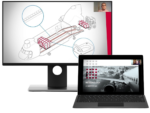
As part of an approved course, you’ll be required to log 16 hours of online tuition for the IR course. This can be met by attending two days of one of our ATPL revision courses.
Our revision courses are delivered at ATPL level, so they may include some content not relevant to the IR syllabus, but your course materials are IR-specific.
The online revision weeks are interactive, so you’ll be able to ask the instructor questions as you go along.
Free 12 Month Subscription to the BGS Question Bank
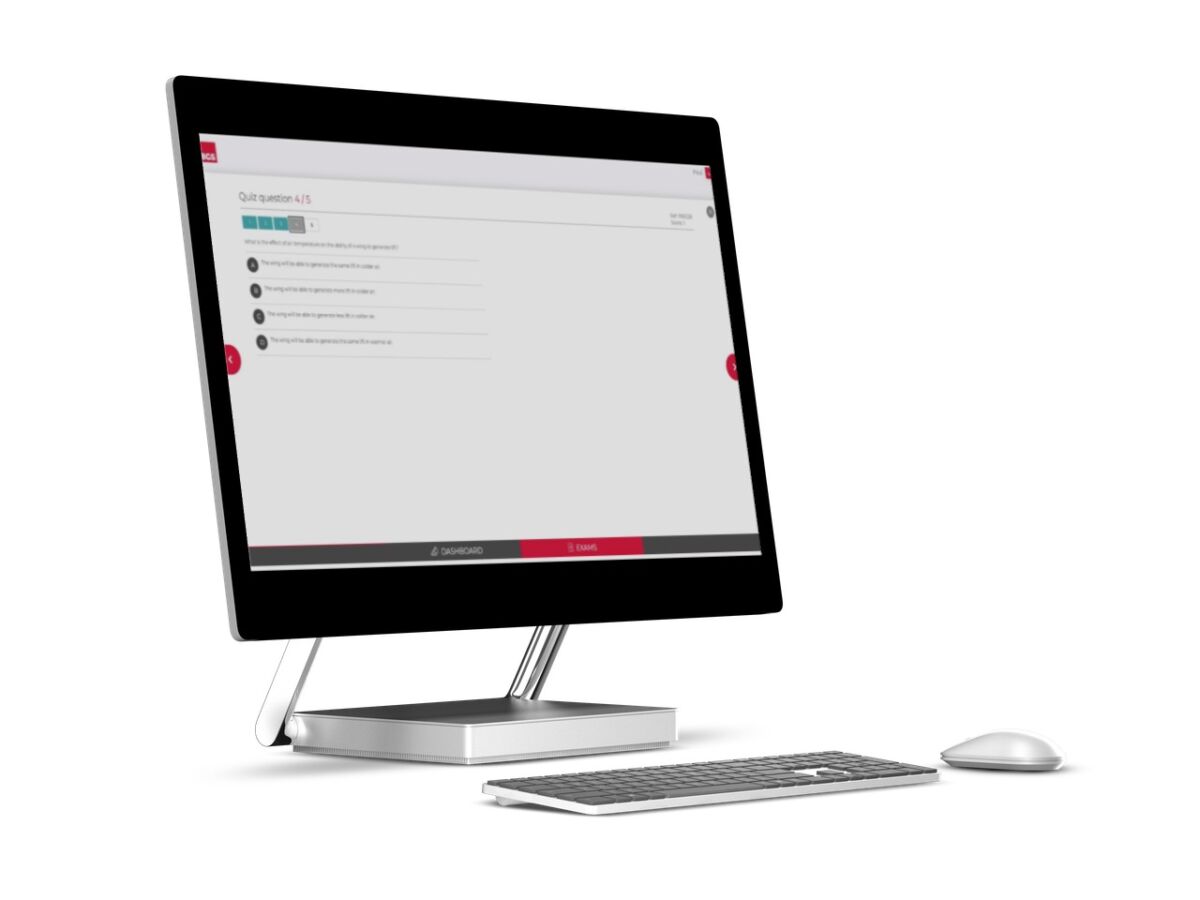 As a student studying with Bristol Groundschool, you will receive twelve months of access to BGS Question Bank: a regularly updated database of exam-style questions.
With instant answers and detailed explanations, it’s the perfect resource for testing your knowledge and preparing for your exams.
Filter questions by topic or revisit questions you’ve got wrong in the past to make your learning targeted and effective.
Frequently Asked Questions About Our IR Courses
What is an instrument rating course and why do I need one?
An instrument rating (IR) course covers the theoretical knowledge requirements for flying under Instrument Flight Rules (IFR) during periods of low visibility or where the airspace requires flights to be conducted under specific navigational criteria. An IR rating allows pilots to fly under IFR en route or allows instrument departure or arrival procedures to be used.
Without an IR, you can only fly under Visual Flight Rules (VFR) which limits the type and nature of flying a pilot can conduct. As a result an IR is almost always required for pilot roles but especially for commercial passenger, charter or emergency service operations. Even PPL holders can find that an IR is a useful rating to add to their licence as it allows them to fly more regularly and equips them with the ability to fly in conditions that your average PPL holder would avoid.
What are the different types of instrument rating courses?
There are several IR types to fit different needs and budgets. The full IR is an ICAO rating and can be added to a PPL, CPL or ATPL. You can get single-engine (SEIR) or multi-engine (MEIR) versions.
The CB-IR (Competency-Based IR) gives exactly the same flying rights as the full IR but has less stringent training requirements for pilots who have previous IR experience. This can make the training considerably shorter and cheaper. The final skills test is exactly the same as the full IR so pilots will need to demonstrate the same level of competence whether the full IR or CB-IR route is taken.
Private pilots often choose the Basic Instrument Rating (BIR) for EASA licences or Instrument Rating (Restricted) (IR(R)) for UK CAA licences. Both cost much less than a full IR and are suited for light aircraft. You can fly instrument departures and approaches and there are single-engine or multi-engine versions. The BIR/IR(R) are not useable on high performance aircraft.
Both the BIR/IR(R) give similar benefits and cost about the same. The big difference is that IR(R) is only useable in UK airspace in UK registered Aircraft whereas the BIR is only available for EASA licence holders flying EASA registered aircraft.
Each course has different theory and practical requirements. The CB-IR and IR have 7 exams, the BIR has 3 exams and the IR(R) has one exam.
Do I need an IR qualification with every licence?
ATPL and MPL pilots must have an IR – their licence won’t work without one. For all other licences like PPL, CPL, and ATPL(H) VFR, the IR is your choice but we strongly suggest getting one.
Most professional pilots need an IR to get jobs, even when the type of flying doesn’t require it. Private pilots find that an IR changes their flying from a sunny-day hobby into a reliable method of travel they can use all year. The money you spend on training usually pays for itself through less weather delays for example.
Can I take an instrument rating course at any point?
Yes, you can add an IR to your licence at any time, but you need to meet some basic requirements first. You must have at least 50 hours of cross-country flying (with 10 hours in your type of aircraft) and a night rating if you want to fly IR at night.
The best time depends on your flying plans. Many students get a BIR or IR(R) early in their training. This gives them good experience while building hours. Later, they can upgrade to a full IR when they need it for commercial work. This way works well and saves money whilst building real IFR skills.
How do IR courses differ for helicopter pilots?
Helicopter pilots have fewer choices but the same basic needs. Only the full IR(H) works for helicopters – there’s no BIR or CB-IR for rotorcraft.
The theory course is the same as for aeroplane pilots, covering seven subjects. But the content includes helicopter-specific information where needed. Flight training covers helicopter procedures and typically requires 50-55 hours total including simulator time. Helicopter pilots who already have a CPL(H) or ATPL (H) VFR can skip some theory exams, making their course shorter.
How is an Instrument Rating theory course structured?
You have a total of 6 sittings (exam weeks) to pass all the exams and no more than 4 attempts at any one subject, you need to pass all exams within 18 months from the date of your first sitting.
The scheduling of the exams is down to a students personal preference as long as the mandatory training requirements of the training organisation are met.
Maths and Physics
Before you start the IR subjects, there is a short module on Maths and Physics with the BGS course. This is a refresher for you if you have not studied these subjects for a while. The Maths and Physics module is conducted in the CBT only and there are no EASA or UK CAA exams associated with it.
What are the prerequisites for an IR course?
You can start your IR theory training with Bristol Groundschool before your Private Pilot’s Licence (PPL) licence is issued, but you will need to hold at least a PPL and FRTOL before starting an IR flight training course, with at least 50 hours Cross Country time as Pilot in Command. You can also start if you have a CPL or an ATPL. If you only have a PPL and want to fly IR at night, you’ll also need a night rating first.
Of course, our modular approach means you can complete these prerequisites at your own pace and fit them around your schedule, rather than rushing through an intensive course.
Instrument Rating Course Subjects and Exams
There are 7 subjects in a full IR, although you may be exempt for two or three subjects (see ‘exemptions’ below).
Module 1 contains:
- Aircraft General Knowledge – Instrumentation
- Human Performance
- Radio Navigation
Module 2 contains:
- Air Law
- Flight Planning and Monitoring
- Meteorology
- Communications
When you have completed each module you may attempt the examinations at a UK CAA or EASA Examination Centre depending on what licence you are looking to achieve.
You must register with your chosen authority once you are ready to book the exams, fees are payable at the time of booking. You could sit your exams with any EASA Authority if you are aiming for an EASA licence.
Bristol Groundschool is a UK CAA and an EASA (Austro Control) examination centre so, subject to availability, you could sit your exams at our examination centre.
Exemptions
If you have already been issued with a CPL, you are exempt from Meteorology, Human Performance and Communications*
If you are adding an IR to your ATPL(H), you are exempt from doing Instrumentation, Meteorology, Human Performance and Communications*.
* Prior to the introduction of the 2020 exams, you would have been exempted only 091 VFR Communications. EASA are clear that the exemption now applies to 090 Communications. However, the UK CAA advice is ambiguous. We are seeking clarification of this point but, until we have an answer, if you hold a UK CPL or ATPL(H) and are seeking to add an IR to your rating, we recommend that you ask the CAA for advice.
How long will the Instrument Rating course take to complete?
Your IR theory course with Bristol Groundschool will usually take around four to six months to complete depending on your personal circumstance.
ATPdigtal records your progress with a series of short quizzes at the end of each lesson (which require 100% to pass), as well as larger progress tests to conclude each topic. ATPdigital automatically sends us the results and our instructors are available throughout the process to provide all the support you will need.
IR Distance Learning Course Fees
 To register for our IR distance learning courses, simply purchase online. You will have the option of paying for your course online by credit or debit card, by bank transfer, or with a card on the telephone. You may pay online in GBP or your own currency; a conversion will be made at checkout. Payment by other methods must be made in GBP. The fees for the various options are calculated before checkout.
Purchase Instrument Rating (IR) Course (Fixed Wing and Helicopter)
 Subscribe to the BGS Newsletter
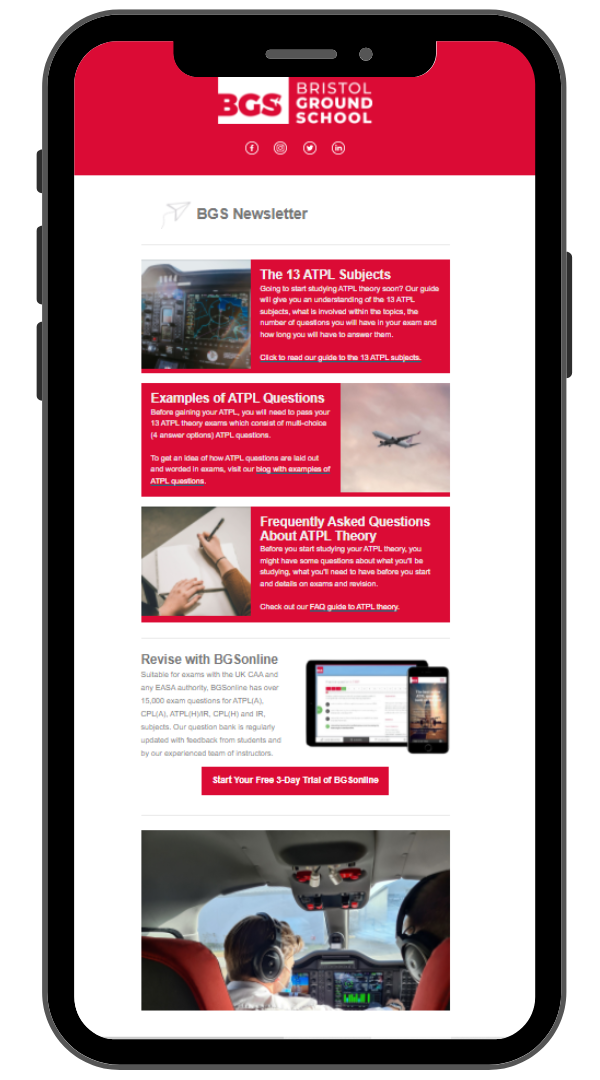
Be the first to know about aviation training news by signing up for the BGS newsletter – updates sent straight to your inbox.
Training Resources, Tips and Blogs
Links to essential guides, tips and blogs all about pilot training.
Aviation Industry and Flight Training News
Packed with aviation news from across the world, including pilot training news stories that you’ll want to read.
Exclusive Content and BGS News
Updates about our courses and training materials plus offers you won’t want to miss.