
Have you ever been in an airport or plane and wondered what certain signs or markings meant on the runway?
Airports are bustling hubs of activity, where meticulous organisation and safety protocols are paramount. Among the crucial elements that contribute to the smooth operation of airports are runway signs and markings. These visual cues serve as indispensable guides for pilots, ensuring safe and efficient takeoffs and landings.
Runway Markings
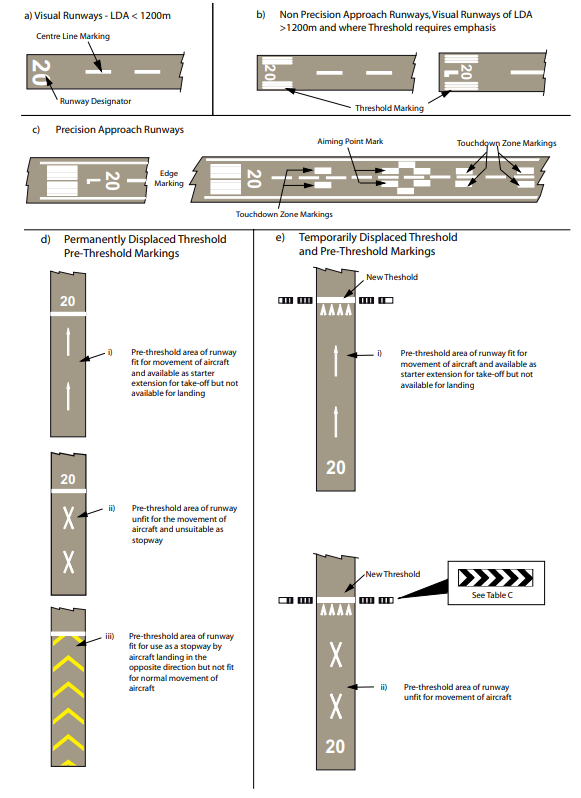
A) Visual Runways – LDA > 1200
Visual runways rely primarily on visual references for pilots to safely navigate and land aircraft. When the Landing Distance Available (LDA) exceeds 1200 meters, visual runways provide ample space for aircraft operations, allowing pilots to make visual judgments without the need for precise instrument guidance. These runways typically have well-defined markings and signs to assist pilots during takeoff, landing, and taxiing.
B) Non-Precision Approach Runways, Visual Runways of LDA > 1200m, and Threshold Emphasis
Non-precision approach runways refer to runways where instrument approaches do not provide vertical guidance, relying on lateral guidance instead. In the case of visual runways with an LDA exceeding 1200 meters, threshold markings assume added significance. These markings, usually in the form of white stripes across the runway, highlight the beginning of the runway available for landing. Pilots rely on these markings to identify the touchdown zone accurately and maintain proper alignment during landing.
C) Precision Approach Runways
Precision approach runways are equipped with sophisticated instrument landing systems (ILS) or other precision-based guidance systems. These runways offer precise vertical and lateral guidance to pilots during approaches and landings, even in adverse weather conditions with reduced visibility. Runway markings and lighting systems are meticulously designed to assist pilots in aligning their aircraft and making precise touchdown and rollout.
D) Permanently Displaced Threshold and Pre-Threshold Markings
In certain cases, the threshold of a runway may be permanently displaced from its original location. This displacement is often due to obstructions, such as buildings or terrain, which necessitate the adjustment of the runway threshold. To inform pilots about the new threshold location, permanently displaced threshold markings are used. These markings consist of white arrows pointing towards the new threshold and are accompanied by pre-threshold markings that provide additional visual cues and guidance.
E) Temporarily Displaced Threshold and Pre-Threshold Markings
Temporary displacements of runway thresholds may occur during construction, maintenance, or other operational requirements. In such cases, temporary displaced threshold markings are utilized. These markings, similar to permanently displaced thresholds, feature white arrows indicating the new threshold location. Pre-threshold markings may also be employed to provide further clarity and assist pilots in their approach and landing procedures. These temporary markings play a vital role in ensuring pilots are aware of the adjusted threshold and can safely execute their landing procedures accordingly.
Lighting
Runway Lighting
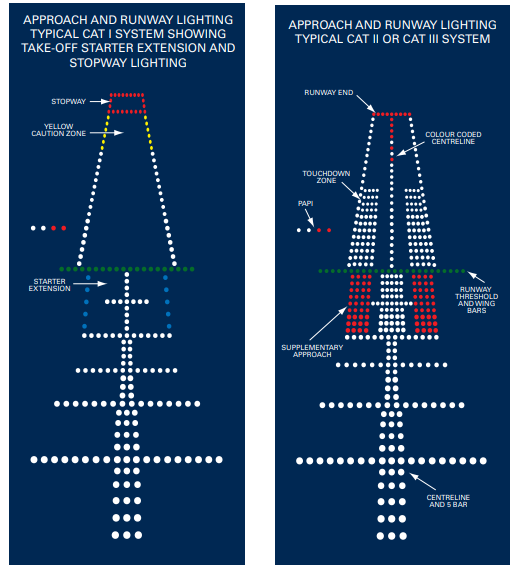
The most basic layout of lighting you will see on a runway is marked as; threshold with green, edge with white, and end with red. In some cases, you may also be able to see a lighting system that begins a few hundred meters from the threshold – it helps in the case of poorer visibility.

At those aerodromes where Category II and III approaches are conducted, Supplementary Approach Lighting consisting of centreline barrettes and two rows of red side barrettes is installed in order to provide the pilot with enhanced visual cues over the last 300 m of the approach.
Precision Approach Indicators (PAPIs)
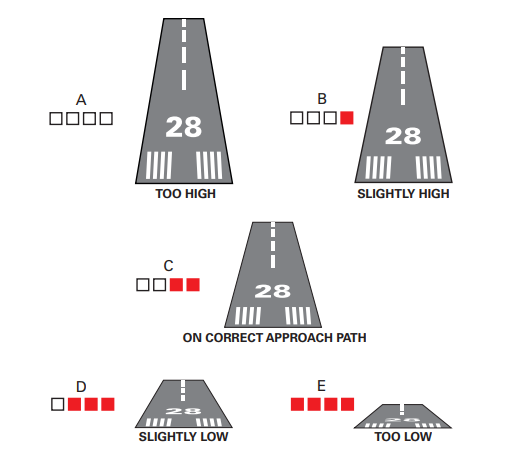
PAPIs are visual aids that provide crucial guidance to pilots during the approach and landing phase of a flight. These devices consist of a row of lights typically installed on the left side of the runway. PAPIs offer precise visual references to help pilots maintain the correct glide path to the runway. The lights emit a combination of red and white signals, creating a visual indicator that allows pilots to assess their vertical position in relation to the desired glide path. When the aircraft is on the correct glide path, the pilot will observe two white lights and two red lights. If the aircraft is below the glide path, additional red lights will be visible, indicating the need to adjust the descent rate. Conversely, if the aircraft is above the glide path, additional white lights will be visible, signalling the need to lower the aircraft’s descent rate.
Mandatory signs and holding points
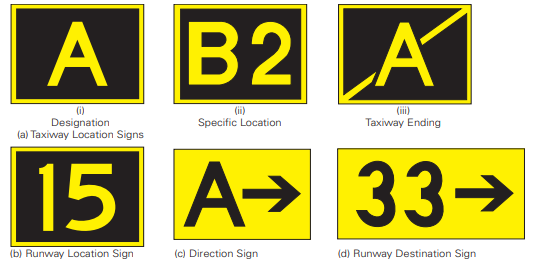
Mandatory signs and holding points are essential elements of airport runway operations, ensuring safety and efficient traffic management. Mandatory signs are prominently displayed signs that convey mandatory instructions to pilots. These signs indicate crucial information such as runway entrances, exits, taxiway intersections, and runway holding positions. They guide pilots and help them navigate the airport surface safely, preventing runway incursions and maintaining orderly movement.

Holding points are designated locations on taxiways where aircraft must come to a stop and hold before entering a runway or an intersection. These points are marked with specific runway holding position markings. Holding points play a vital role in maintaining separation between aircraft, allowing air traffic controllers to manage the flow of traffic and ensure safe operations. By adhering to these holding points, pilots contribute to the overall safety and efficiency of runway operations.

Together, mandatory signs and holding points form an integral part of the comprehensive visual system at airports, helping pilots, ground crew, and air traffic controllers work in harmony to ensure smooth and secure movement on the airfield.
Location and destination signs
Location signs serve as navigational aids, assisting pilots in identifying their position on the airport surface. These signs are strategically placed throughout the airport and provide directions to key areas such as taxiways, gates, ramps, cargo facilities, and other important locations. By referencing location signs, pilots can accurately navigate the airport and ensure safe and efficient movement of aircraft.
Destination signs, on the other hand, guide pilots and ground personnel to specific destinations within the airport. These signs indicate the direction and distance to important facilities like terminals, maintenance areas, fueling stations, and other vital services. By following destination signs, pilots can quickly and accurately navigate to their intended locations, streamlining ground operations and enhancing overall efficiency.
Visual Communication and signage
Meaning of signals displayed in the signals area
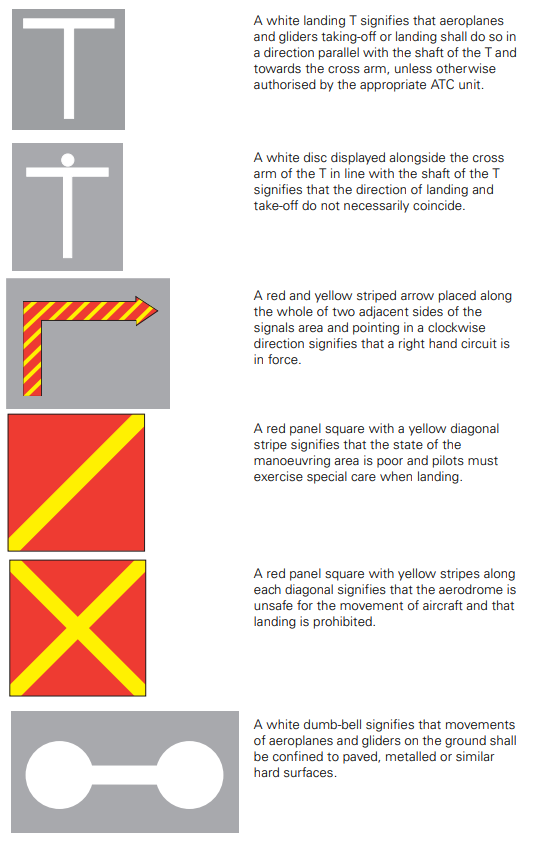
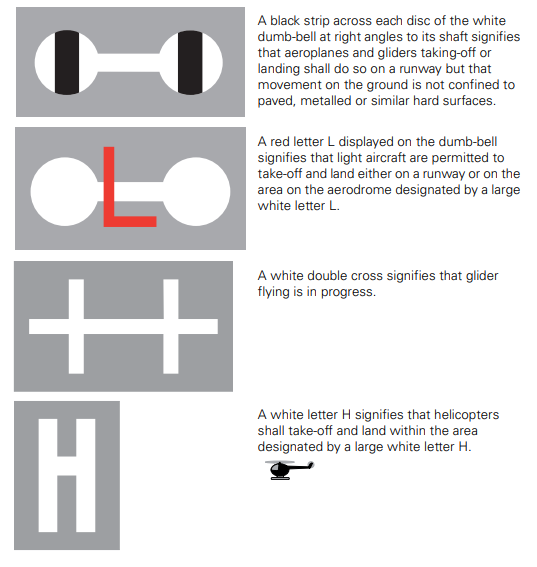
Meaning of signals displayed on the aerodrome

Runway signs and markings are not merely decorative features on airport surfaces but serve as indispensable guides for pilots and ground crew members. By providing vital information, these visual cues enhance safety, prevent runway incursions, and facilitate smooth operations at airports. Adhering to international standards and regulations ensures that airports worldwide maintain a high level of safety and efficiency. So, the next time you witness these signs and markings at an airport, remember their vital role in ensuring safe takeoffs and landings for all air travelers.