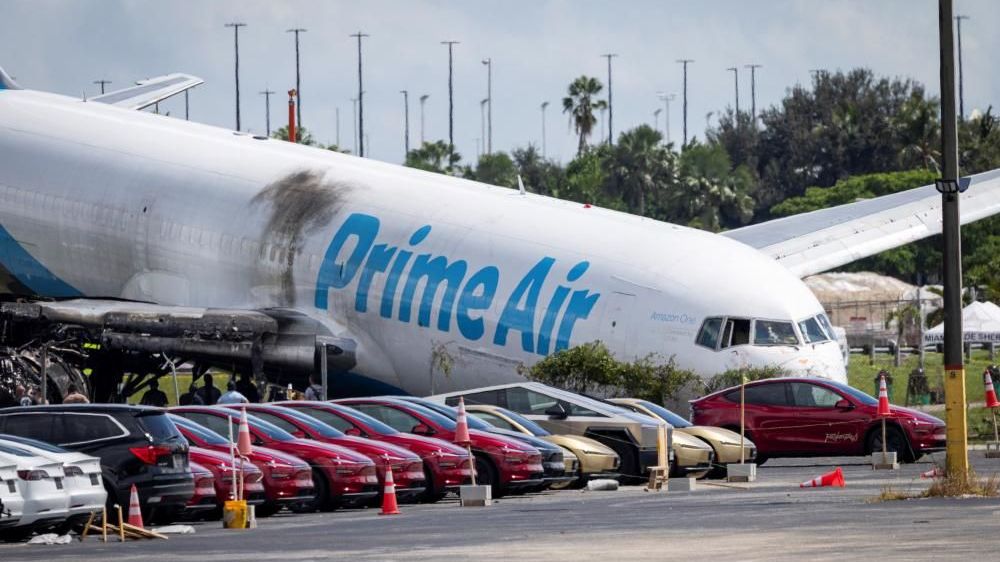
On 6 September, Prime Air Flight 7598, a Boeing 767-300 freighter operated by 21 Air, overran the runway while landing at Miami International Airport (IATA: MIA, ICAO: KMIA).
The aircraft had arrived from San Juan and was landing on Runway 30 when it failed to stop within the paved runway. It continued beyond the airport boundary, striking equipment and vehicles before eventually coming to rest. Five people on the ground were killed and several others were injured.
The investigation is still at a very early stage, and there is a lot we don’t yet know about why the aircraft overran. Investigators will be looking at everything from aircraft performance and braking to weather systems (thunderstorms were reported in the area), and human factors before any conclusions can be drawn.
But one detail already being examined is particularly relevant from a training perspective: where, and at what speed, the aircraft touched down.
Video of the accident appears to show the 767 remaining airborne well beyond the beginning of the runway before eventually touching down. The NTSB is now examining the aircraft’s speed and whether the landing should have been discontinued.
And that raises an interesting question.
At what point does continuing with a landing become a greater risk than going around?
It’s something pilots are introduced to relatively early in training. A stable approach isn’t simply about arriving over the threshold looking roughly right. The aircraft needs to be in the right configuration, at the right speed, on the correct flight path and in a position from which the landing can be completed safely.
If those conditions aren’t met, the answer is straightforward: go around.
On paper, at least.
In reality, the decision isn’t always quite so easy. Once an aircraft is close to the runway, there is a natural expectation that the next thing that happens will be a landing. You’ve flown the approach, configured the aircraft, received the clearance and can see the runway ahead. The entire sequence has been building towards touchdown.
That makes the point at which you abandon the landing particularly interesting from a human factors perspective.
One concept we teach is plan continuation bias, sometimes described more simply as “press-on-itis”. Once someone has committed time and effort to a plan, there can be a tendency to continue with it even when the conditions that originally made it appropriate have started to change.
That doesn’t mean this is what happened in Miami. Until the investigation is complete, we simply don’t know.
But the accident provides a useful real-world context for understanding why stabilised approach criteria and go-around policies exist in the first place.
Landing performance calculations make assumptions. Touchdown distance is one of them.
An aircraft that crosses the threshold at the expected height and speed and touches down within the expected touchdown zone has a known amount of runway remaining in which to decelerate. If touchdown occurs further along the runway, that distance disappears quickly.
The same applies to speed. Even a relatively small increase in groundspeed means more energy has to be dissipated through aerodynamic drag, wheel braking and reverse thrust. Put a later touchdown and additional speed together and the stopping margin can look very different from the one originally planned.
This is where Performance, Operational Procedures and Human Performance stop being separate ATPL subjects and start becoming one operation.
Performance tells us whether the aircraft can stop.
Operational Procedures give us the framework for deciding whether the approach and landing should continue.
Human Performance helps us understand why making that decision at the right moment isn’t always as simple as it appears in a textbook.
There is another part of the Miami accident that investigators are looking at too. The airport did not have an Engineered Materials Arresting System (EMAS) beyond the runway, although it was compliant with FAA requirements because the runway had the required safety area. Investigators will consider whether an arresting system could have changed the outcome.
Again, it’s too early to draw conclusions. But it is another reminder of something that comes up repeatedly in aviation safety: accidents are rarely understood by looking at one decision, one person or one system in isolation.
There are layers: aircraft performance, procedures, crew decisions, airport design and physical safety measures, all intended to prevent an abnormal situation becoming an accident.
For students working through ATPL theory, that’s perhaps the most useful reason to follow investigations like this one.
The subjects we study separately aren’t separate once you’re in the aircraft.
A landing distance calculation isn’t simply a Performance exam question. Stabilised approach criteria aren’t just something found in Operational Procedures. And understanding continuation bias isn’t confined to HPL.
They all meet at the same point: deciding whether the aircraft can still safely do what you intended it to do.
We don’t yet know why Prime Air Flight 7598 overran the runway at Miami, and it would be wrong to use the information available today to reach conclusions about the crew or the cause of the accident. The NTSB investigation will establish a much clearer picture in time.
But while we wait for those findings, it does give us a real-world example of why one of the simplest decisions taught in flight training can also be one of the most important.
If the landing isn’t developing as planned, at what point are you prepared to stop trying to make it work?