
For most pilots in training today, GPS is just part of the background. It’s there from the start, moving maps, RNAV approaches, direct-to routing. You learn how to use it early, and very quickly it becomes something you rely on without really thinking about it. Most of the time, it just works.
Which is exactly why it’s easy to overlook what happens when it doesn’t.
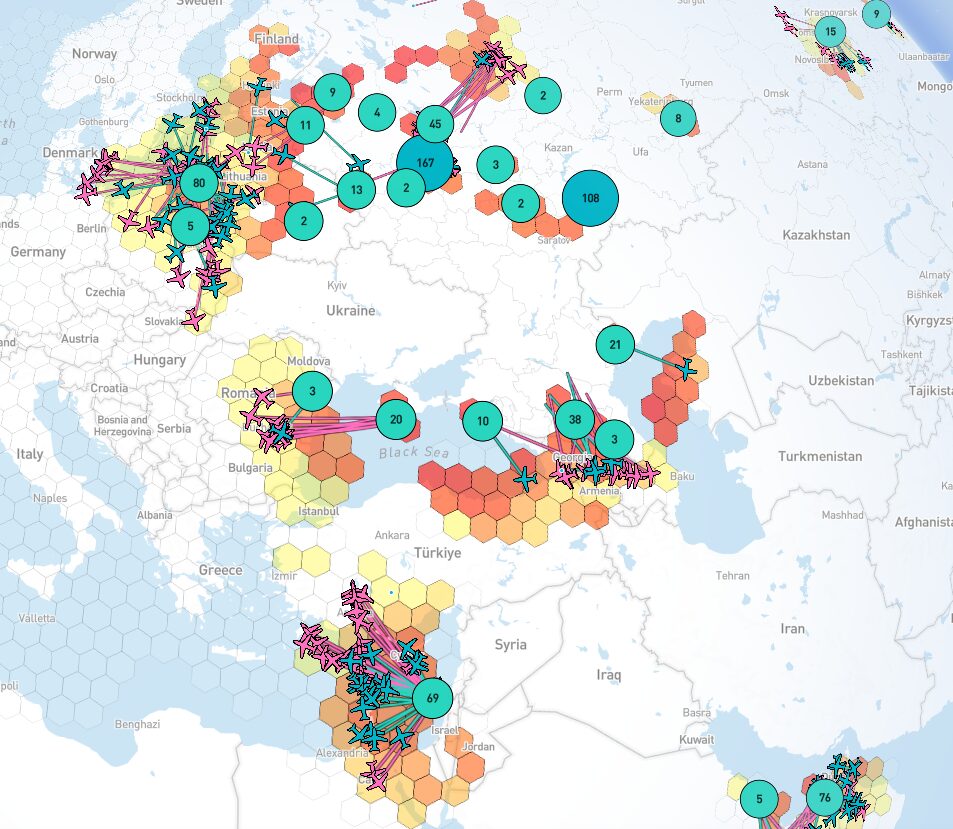
Over the past year, reports of GNSS interference across Europe have been increasing, particularly in areas closer to conflict zones in the East. Aircraft have experienced everything from degraded accuracy to complete signal loss, and in some cases, misleading position information rather than a clear failure.
EASA and EUROCONTROL have recently published a joint action plan in response, focusing on improving reporting, increasing awareness, and strengthening procedures for operating in degraded GNSS environments. It’s a sign of how quickly this has moved from a technical concern to something with clear operational impact.
What’s interesting is that this isn’t a technical failure in the traditional sense. The aircraft systems are working as designed. The issue is that the signal they depend on is no longer reliable.
From the cockpit, that can be a subtle problem.
Unlike a clear system failure, where something flags up immediately, GNSS interference doesn’t always announce itself in an obvious way. The position looks valid, the route is still displayed, and unless something doesn’t quite match what you’re expecting, there may be very little to prompt a second look.
That’s where it becomes less about technology and more about how it’s being used.
Modern operations lean heavily on RNAV. Routes, departures, arrivals; all built around the assumption that accurate positioning is available. It’s efficient, it reduces workload, and it’s become the standard way of operating.
But it also means that when the underlying signal becomes unreliable, a large part of the system is affected at once.
For pilots in training, this isn’t always obvious, because GPS is rarely presented as something that can meaningfully degrade. You’re taught how to use it, not necessarily how to manage without it beyond the basics.
And yet, that fallback matters.
Not in a dramatic, “everything fails at once” sense, but in the quieter moments where something doesn’t quite line up. A track that drifts slightly. A position that doesn’t match what you’re seeing outside. A procedure that doesn’t quite behave as expected.
Those are the situations where raw data flying, basic navigation skills, and simple cross-checking become important again. If you have ground-based navigation facilities, then use them.
The challenge is that these skills can fade if they’re not used regularly. When the system works 99% of the time, it’s easy to trust it completely. Reversionary thinking becomes something theoretical rather than practical.
What the current rise in GNSS interference highlights is that reliability isn’t just about the aircraft; it’s about the environment the aircraft is operating in. And that environment is changing in ways that aren’t always visible from the cockpit.
There’s still a lot to be understood about how widespread this issue is and how it will evolve, but the direction of travel is fairly clear. This isn’t a one-off problem, and it’s not limited to a single region.
Which raises a slightly uncomfortable question.
If modern navigation is built on the assumption that GNSS is available and accurate, what happens when that assumption no longer holds?
It’s something the industry is starting to address at a system level. But for pilots, it brings things back to something much simpler, not just how well you can use the system, but how well you can recognise when not to trust it.
And that’s probably not something most pilots think about until they have to.