
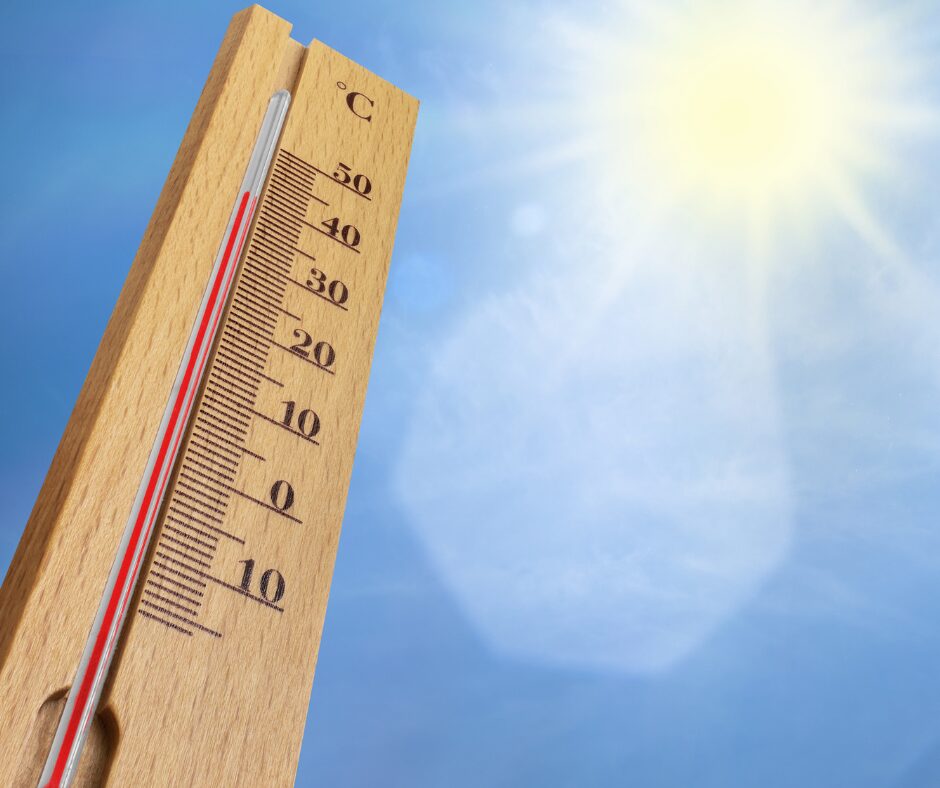
 Phew! When will this hot spell end?
Most of us enjoy the warmer weather that summer brings. However, periods of unusually hot weather are becoming more frequent and are likely to become increasingly common over the coming decades. This needs to be considered during flight planning and operations.
Aircraft performance is closely related to density altitude, which is influenced by the local atmospheric conditions. For example, an airfield with an elevation of 839 ft AMSL can have a density altitude of around 2,800 ft when the outside air temperature reaches 30°C. For a standard Piper PA-28 training aeroplane, this can increase the take-off ground roll by approximately 400 ft. This represents an increase of more than 50%.
The effects continue after lift-off. Hot, humid conditions reduce climb performance, meaning the aircraft will take longer to reach a safe cruising altitude. Returning to our Piper PA-28 example, the rate of climb can reduce from approximately 580 ft/min to 480 ft/min. This is a performance reduction of almost 20%.
These conditions should also influence our engine management. If we are held at the holding point for longer than expected, the temperature of an air-cooled engine can rise rapidly because there is little cooling airflow. Once airborne, it may be necessary to reduce cylinder head temperature (CHT) or engine oil temperature by reducing power and increasing airflow across the engine through a lower rate of climb.
When thinking about warm summer weather, it is easy to overlook the effects of relative humidity (RH). During recent hot spells, RH has frequently approached 80%. For carburettor-equipped piston engines, these conditions can produce moderate carburettor icing at cruise power settings and serious carburettor icing during descent. This risk should be managed with regular and generous applications of carburettor heat.
Having considered the aircraft, we should also consider the people on board. Most light aircraft do not benefit from air conditioning and rely solely on ambient air entering through the cabin vents. Combined with large areas of glazing to improve visibility, the cockpit can quickly become a flying greenhouse. Pilots and passengers should remain well hydrated before and during the flight to help maintain comfort, concentration and overall wellbeing.
All in all, there is a little more to consider when operating in warm conditions, even in the UK and Europe, where the climate is generally temperate and most airfields are at relatively low elevations. High temperatures and humidity can have a significant effect on aircraft performance, engine management and pilot wellbeing. With careful planning and an appreciation of these effects, hot weather flying can remain both safe and enjoyable.