
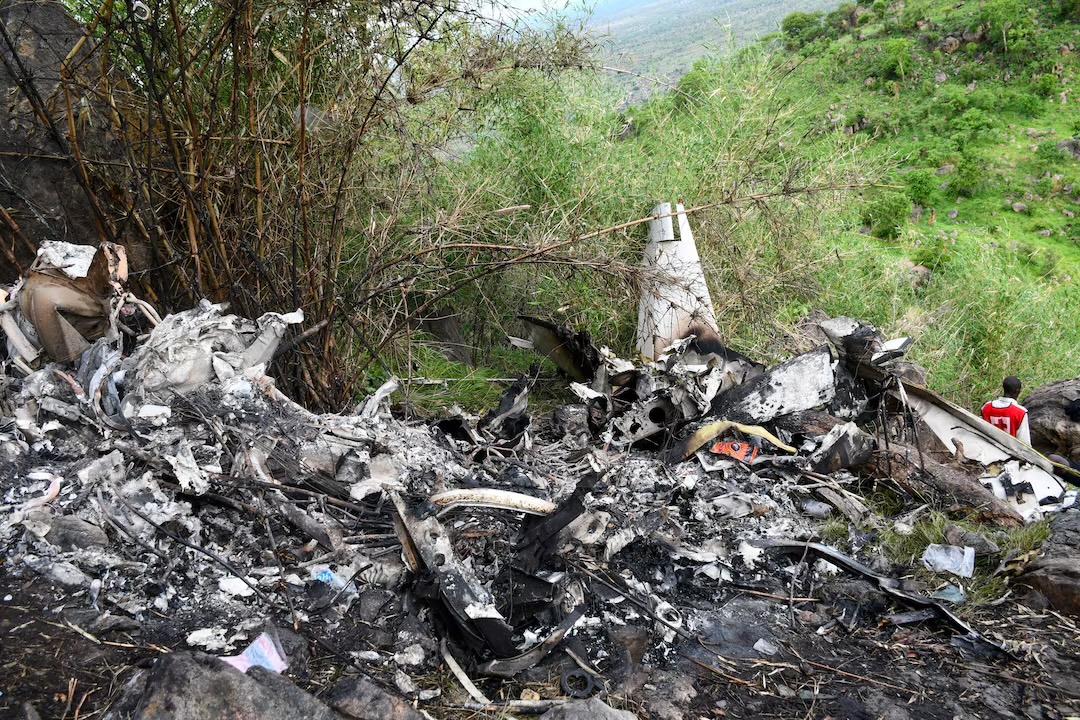
At first glance, it’s easy to focus on the conditions surrounding the Juba crash.
The incident involved a small passenger aircraft crashing while en route to Juba, with early reports mentioning reduced visibility at the time. All 14 people on board were killed. As with any accident, the full sequence of events will take time to establish.
But focusing on the conditions alone doesn’t really explain how the outcome develops.
In aviation, challenging environments are something pilots are trained to operate in. Procedures exist, limits are defined, and there are always options available; delay, divert, or go around. The presence of a threat doesn’t make an outcome inevitable.
So the more useful question isn’t just what the conditions were, but how they influence a situation as it develops.
In training, these kinds of conditions are best thought of as a threat, something external that increases workload, reduces situational awareness, and makes it harder to build an accurate picture of what’s happening. It doesn’t cause an accident by itself, but it changes the environment in a way that makes everything else more demanding.
That’s where things start to shift.
As the environment becomes more challenging, the margin for error begins to reduce. Cues become less reliable, cross-checking becomes more difficult, and workload increases as more attention is needed to maintain control and situation awareness.
None of that is inherently unsafe in isolation. It’s exactly what pilots are trained to manage.
But it does mean the system is operating with less buffer.
More often, situations like this develop as a sequence. A scenario that gradually becomes less stable than intended, or where a developing issue isn’t recognised as early as it could be.
That doesn’t describe any one event in isolation, but it does reflect how aviation incidents tend to evolve collectively.
Aviation has long recognised that safety depends on multiple layers of defence, something we teach through concepts like Threat and Error Management (TEM)and the Swiss Cheese model. Most of the time, those layers work exactly as intended. But when several small gaps begin to align, whether through workload, timing, or system design/latent errors, the buffer between normal operation and something more serious can narrow very quickly.
In that context, the conditions aren’t the cause. They’re the starting point.
What matters is how the situation adapts around them.
Was there a clear point where the plan should have changed?
Was the developing situation recognised early enough?
Was there a comfortable margin still available?
Those questions sit less in theory, and more in decision-making and operational discipline.
It’s also where training plays a quieter but important role. Skills like recognising when a situation is no longer developing as expected, being comfortable changing the plan, and acting early rather than late are all straightforward in isolation. But under pressure, they rely on habits that have been built over time.
That’s why events like this are rarely about a single factor.
What matters is how multiple elements interact – workload, expectations, timing, and the decisions made along the way.
There’s still a lot we don’t know, and the final report will be key in understanding exactly how this sequence developed.
Without drawing conclusions about this specific event, it reflects a pattern that appears consistently across aviation safety.
The environment doesn’t have to fail for the margin to reduce.
And when that margin starts to shrink, it often does so gradually, without being obvious in the moment.
That’s what makes it worth paying attention to.