
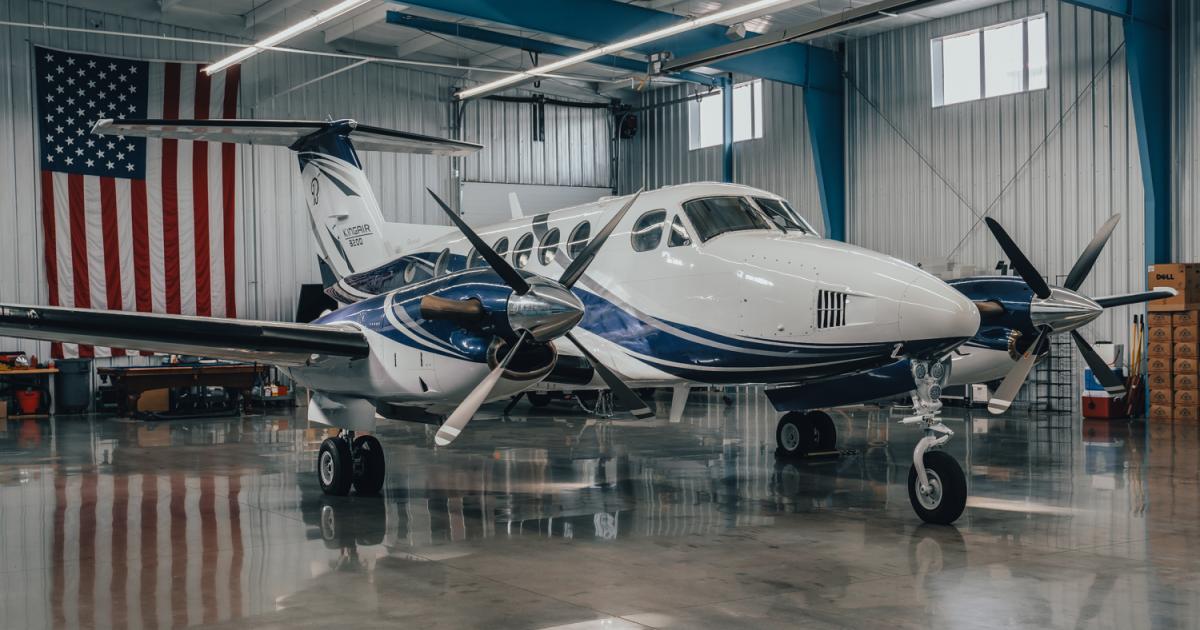
On 20 December, the pilots of a Beechcraft King Air 200 experienced a pressurisation problem that led to the activation of Garmin’s Autoland function. The aircraft subsequently landed safely at Rocky Mountain Metropolitan Airport in Colorado. As the system was originally developed to address pilot incapacitation, it automatically shuts down the engines after landing, allowing emergency services to approach and board the aircraft safely. In this case, the crew were fortunately found to be in good health.
In the King Air 200, should the cabin altitude climb to approximately 10,000 ft, a Master Warning is triggered. Should an emergency descent be required, the procedure involves bringing the power levers to idle and the propeller levers fully forward. At a maximum of 200 knots, flaps are set to approach and, at a maximum of 181 knots, the landing gear is lowered – but before any of this, the oxygen masks must be donned. At a cruising altitude of 25,000 ft, the time of useful consciousness is typically between three and five minutes. These procedures are practised repeatedly in the simulator until they become instinctive, but that assumes the pilot is in perfect health. Attempting to carry out such actions while suffering a medical emergency is a sobering thought.
Garmin’s Autoland system can arm automatically when specific criteria are met, or it can be activated at the push of a button, after which it takes full control of the aircraft and guides it safely to the ground.
This technology demonstrates how innovation continues to enhance aviation safety, particularly in single-pilot operations. The King Air 200 is single crew certified, making Autoland an invaluable safety net. In 2011, a pilot flying a Citation Mustang single crew suffered a stroke yet managed, despite partial paralysis, to land safely – a truly extraordinary feat. However, pilots are human, and incapacitation can occur without warning.
I have personally experienced incapacitation, though fortunately in a multi-crew environment where another pilot provides an essential safety barrier. In single-pilot commercial operations, that layer of protection did not previously exist – until now.