
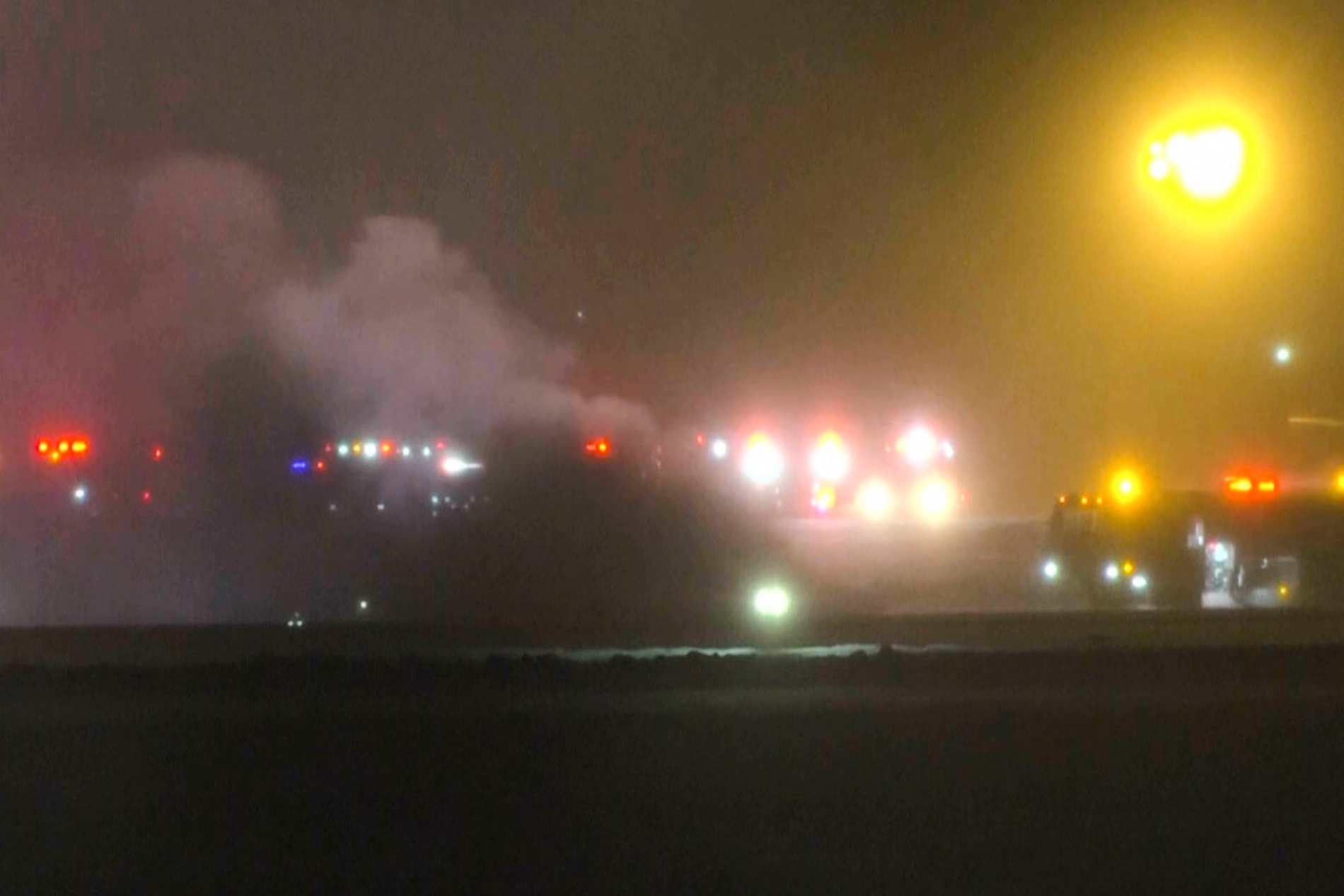
A Bombardier Challenger 650, registration N10KJ, crashed very shortly after take-off from runway 33 at Bangor International Airport (KBGR) at approximately 19:45 local time on Sunday, 25 January 2025 (00:45 UTC on Monday 26 January). Six people were reportedly on board the aircraft, and there have been no reports of survivors.
The aircraft had arrived earlier from Houston, Texas, landing at Bangor to refuel before continuing on to Châlons Vatry Airport (LFOK) in France. The accident occurred during the take-off phase, one of the most performance-critical moments of any flight.
Weather Conditions at Bangor
At the time of the accident, weather conditions at Bangor were consistent with active winter operations. The reported METAR was:
METAR KBGR 260053Z 04009KT 3/4SM R15/6000VP6000FT -SN VV011 M17/M19 A3035 RMK AO2 PRESFR SLP286 P0002 T11671194=
In practical terms, this indicates:
- Wind: North Easterly at 9 knots
- Visibility: 0.75 statute miles (approximately 1200 metres)
- Weather: Light snow and mist
- Cloud: Vertical Visibility 1100 feet AGL
- Temperature: –17°C
- Dewpoint: –19°C
These conditions place the aircraft squarely in an environment where airframe icing is a known and continuous risk, both on the ground and during initial climb.
De-Icing, Anti-Icing, and Timing
Any contamination on an aircraft’s lifting surfaces, even a thin layer of frost or snow can increase drag by up to 40% due to the deformation of the aerodynamic surfaces and reduce lift by as much as 30% by disturbing the airflow over the upper surface of the wing, it can also restrict airflow into the engines degrading performance at precisely the point where maximum performance is required.
The airport director has confirmed that de-icing operations were in progress, and it is therefore reasonable to assume the aircraft was de-iced before departure. However, it is important to distinguish between de-icing and anti-icing:
- De-icing is the removal of existing ice or snow contamination.
- Anti-icing is the prevention of further contamination, typically through the application of protective fluid.
Ground de-icing/anti-icing can be carried out either in one or two stages. De-icing is reactive, removing the icing. Ant-icing is proactive, stopping it from forming later on.
One step de-icing/anti-icing is where heated anti-icing fluid is applied to the aircraft surfaces; the heat de-ices the aircraft, and the fluid remains on the aircraft to provide sufficient anti-icing capability, the hold-over time begins at the start of the single stage.
Two step de-icing/anti-icing means that the first stage applies a dedicated de-icing fluid, and then the second stage applies a dedicated anti-icing fluid, here the hold-over time begins at the start of the second (anti-icing) stage.
The given hold-over time is the time that the aircraft is sufficiently clear of icing and contaminants, if the aircraft does not take-off within this time, they must return to be de-iced / anti-iced.
The hold-over time is usually found using a table and depends on variables like the type and rate of precipitation, ambient temperature, relative humidity, wind velocity; including jet blast from taxying aircraft, aircraft skin temperature and the type of fluid, the ratio of the mixture and fluid temperature.
Early reports, which should be treated with appropriate caution, suggest there may have been an approximately eight-minute gap between completion of de-icing and the aircraft’s departure from runway 33. In the prevailing weather, this interval may have exceeded the effective holdover time of the anti-icing fluid, potentially allowing snow or ice to accumulate again on critical surfaces.
On the Challenger 650, wing anti-ice protection relies on fluid being expelled through pores along the leading edge. When the aircraft is stationary or moving slowly on the ground, this fluid does not flow back across the wing as effectively as it does in flight. Untreated surfaces can therefore remain vulnerable, particularly in visible moisture at temperatures between 0°C and –20°C, exactly the conditions present at Bangor.
The National Transportation Safety Board (NTSB) will examine this closely as part of its investigation. Some reports have suggested that the departure may have been expedited to “get ahead” of an incoming storm, which may have compressed decision-making timelines.
Performance Effects of Snow, Ice, and Freezing Conditions
Snow and ice contamination has a well-documented effect on aircraft performance, particularly during take-off:
- Reduced lift due to disturbed airflow over the wing
- Increased drag, requiring more thrust and a longer take-off distance
- Degraded control response at low airspeeds
- Reduced braking effectiveness on snow- or ice-covered runways
The Challenger series is not unique in this regard. There have been previous accidents involving similar aircraft during take-off where wing contamination was identified as a contributing factor, underlining how little margin exists in these conditions.
Decision-Making in Deteriorating Conditions
Winter operations often involve rapidly changing conditions, where decisions made minutes apart can carry very different risk profiles.
In this case, there were reportedly conversations between other flight crews operating at Bangor around the same time. One transmission in particular is noteworthy. Another crew elected to taxi back to the gate, stating:
“One, our de-icing fluid has failed, and two, I don’t think the visibility is good enough for us to go, so we’re going to have to taxi back to the gate here.”
This illustrates the dynamic nature of the conditions that evening and the operational judgements crews were being forced to make in real time.
As one BGS instructor explains:
“As a pilot, operational pressures are always present, whether they come from the operations department, delays, passengers needing to reach their destinations, or even your own desire to get home after a long day. However, it’s essential to remember that rules and regulations exist to protect you, your passengers, and other aircraft in the airspace around you.
Being a pilot carries enormous responsibility. Your passengers have entrusted you to get them safely to their destination, whether that’s home to their loved ones or the start of a well-earned holiday. By using these rules and regulations as part of your decision-making process, you create additional layers of defence that help stop hazards before they develop into an accident.”
An article published by AOPA US provides additional context, suggesting that delays may have exceeded anti-icing limits in similar Challenger operations, and highlighting how easily protection margins can be eroded during sustained snowfall.
What Happens Next
The NTSB investigation will focus on a range of factors, including:
- Weather data and snowfall rates at the time of departure
- De-icing and anti-icing procedures and timing
- Aircraft performance and configuration
- Crew decision-making and operational context
Using the Swiss Cheese Model, as with most aviation accidents, it is unlikely that one single error explains what occurred. Instead, multiple layers of defence appear to have failed simultaneously, allowing the hazard to pass through and ultimately result in an accident. The investigation will seek to understand how factors such as weather, timing, aircraft performance, and operational decision-making combined in the moments leading up to the crash.