
As we soar through the boundless expanse of the sky, we are often mesmerised by the breathtaking beauty of clouds. These celestial formations offer glimpses into the dynamics of the atmosphere but also create fascinating landscapes.
The classification of clouds
Clouds are categorised based on their altitude and appearance.
When classified by shape they are two types:
Cumulus clouds which are heaped, convective clouds, basically tall columns of water rising in the atmosphere.
Stratus clouds which are not very thick and are horizontal, layered clouds covering a large area but cannot support large water droplets due to the lack of updrafts and therefore produce drizzle and light rain.
When classified by the altitude of the base of the cloud.
Low Level (no prefix) Surface to 6500 ft Cumulus
Medium Level (prefix Alto) 6500 ft to 23000 ft Alto Cumulus
High Level (prefix Cirro) 16000 ft to 45000 ft Cirro Cumulus
High clouds
High clouds typically occur at altitudes above 20,000 feet (6,000 metres). They are primarily composed of ice crystals due to the low temperatures at such heights.
Examples of high clouds include:
Cirrus Clouds
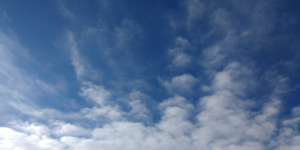
Delicate and wispy, cirrus clouds appear like feathery brush strokes on the sky’s canvas. They often indicate fair weather but can foretell the arrival of an approaching warm front.
Cirrostratus Clouds

These high, thin clouds cover the sky like a translucent veil, causing the sun or moon to appear hazy or surrounded by a halo. Cirrostratus clouds often precede the arrival of a storm system.
Medium clouds
Medium clouds occupy altitudes ranging from 6,500 to 20,000 feet (2,000 to 6,000 metres). They consist of a combination of small and large water droplets and ice crystals in the higher altitudes. Two common types of medium clouds are:
Altostratus Clouds
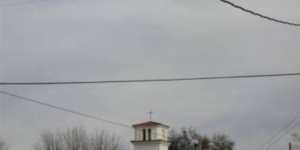
Altostratus clouds appear as a uniform grey or blue-grey layer that often covers the entire sky. They are thick enough to diffuse sunlight, creating a dimly lit atmosphere. Altostratus clouds can be a precursor to rain or snow.
Altocumulus Clouds

Resembling cotton balls or clumps of small rounded puffs, altocumulus clouds form in parallel bands or clusters. They often indicate instability in the atmosphere and can evolve into more significant cumulus clouds.
Low clouds
Low clouds form below 6,500 feet (2,000 metres) and are composed of large water droplets. They can bring overcast skies and potential precipitation. An example of low clouds is:
Stratus Clouds
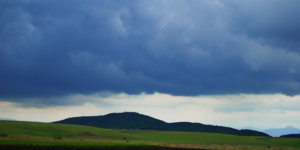
Stratus clouds stretch across the sky as a uniform grey layer, often resembling a fog that has lifted off the ground. They typically bring drizzle, light rain, or snow.
Two types of clouds have their own classification:
Note: Nimbus means rain-bearing.
Nimbostratus Clouds
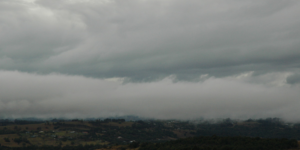
A thick layered cloud, is formed at warm fronts as the warm air is forced upwards over the denser cold air and in doing so is cooled causing rain over a wide area. A feature of warm fronts, Nimbostratus clouds are dark and dense, occupying the sky with a thick layer of precipitation. They often accompany steady, continuous rainfall or snowfall.
Cumulonimbus clouds
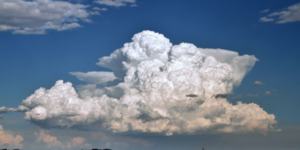
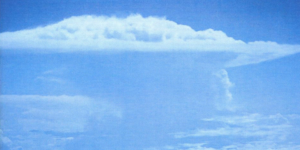
A well-developed cumulus cloud and a feature of a cold front can occur as isolated cumulonimbus in unstable atmospheres where thermal heating is causing the air to rise rapidly creating a tall column of rain-bearing cloud which produces localised heavy rain showers and moderate to severe turbulence.
Special Clouds
Apart from the primary cloud classifications, there are a few exceptional cloud formations that showcase rare and awe-inspiring atmospheric phenomena.
Noctilucent Clouds
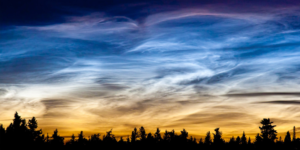
Noctilucent clouds, or “night-shining clouds,” are the highest clouds in the Earth’s atmosphere. They form around 50 miles (80 kilometres) above the ground, near the boundary of the mesosphere and the thermosphere. These ethereal clouds appear illuminated during twilight hours when the sun is below the horizon. Composed of ice crystals, they create stunning displays of delicate, luminous tendrils in the darkened sky.
Contrails
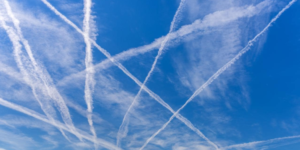
Contrails, short for “condensation trails,” are visible trails of condensed water vapour left behind by aircraft flying at high altitudes. When hot engine exhaust gases mix with the cold air at high altitudes, the water vapour condenses into tiny ice crystals or water droplets, forming long, white streaks in the sky. Contrails can vary in length and persistence depending on atmospheric conditions. They are a common sight in busy airspaces and can sometimes linger for hours, spreading and creating intricate patterns across the sky.
Polar Lights
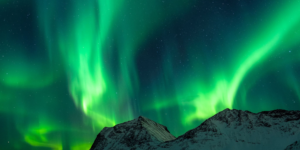
Polar lights, also known as auroras, are not clouds in the traditional sense. However, they are a spectacular atmospheric phenomenon worth mentioning. Auroras occur in polar regions and are caused by the interaction of charged particles from the sun with the Earth’s magnetic field. When these particles collide with molecules in the atmosphere, they emit coloured light displays. In the Northern Hemisphere, they are called the Aurora Borealis or Northern Lights, while in the Southern Hemisphere, they are known as the Aurora Australis or Southern Lights. This celestial light shows paint the night sky with hues of green, pink, purple, and red, creating a mesmerising spectacle for lucky viewers.
If you would like to find out more about meteorology read our Meteorology Blog.